Fox News Breaking News Alert
Ex-Vice President Joe Biden abruptly cancels New Hampshire primary party appearance amid sagging support, heads to South Carolin
02/11/20 9:01 AM
Tuesday, 11 February 2020

Fox News Breaking News Alert
Fox News Breaking News Alert
DOJ expected to scale back Roger Stone's 'extreme' sentencing recommendation: official
02/11/20 8:49 AM
DOJ expected to scale back Roger Stone's 'extreme' sentencing recommendation: official
02/11/20 8:49 AM
New story in Technology from Time: T-Mobile’s $26.5 Billion Sprint Merger Approved Despite Competition Concerns
T-Mobile US Inc. won court approval for its $26.5 billion takeover of Sprint Corp., defeating a state-led lawsuit that sought to block the industry-altering wireless deal.
The decision by a district judge in Manhattan is a huge win for T-Mobile and its owner Deutsche Telekom AG, as well as SoftBank Group Corp., Sprint’s parent. The combined company, which will operate under the T-Mobile name, will have a regular monthly subscriber base of about 80 million — in the same league as AT&T Inc., which has 75 million subscribers, and Verizon Communications Inc., which has 114 million.
After the merger, T-Mobile will have more spectrum — the frequencies through which wireless signals are transmitted — than any other carrier. This larger capacity will give the combined company an advantage as the industry transitions to the next generation of wireless technology, the much-faster 5G standard.
The ruling comes almost two years after the deal was first announced. The states’ lawsuit was the last major hurdle to the deal after it secured the blessing of regulators at the Federal Communications Commission and Justice Department’s antitrust division. It still needs approvals from California’s utility board and a federal judge in Washington who must sign off on the Justice Department settlement.
Deutsche Telekom shares rose as much as 3.6% to 15.40 euros in Frankfurt. Shares of Sprint soared 66% to $7.95 in pre-market trading in New York after closing at $4.80 Monday in New York. T-Mobile extended gains to as much as 8.4% to $91.88.
The ruling is also a victory for Dish Network Corp. co-founder and Chairman Charlie Ergen, who is buying assets from the two carriers to set up a new wireless network. With his company’s core satellite TV business in decline, Ergen has amassed a trove of airwaves to build a state-of-the-art network.
Concessions
To win federal approval, T-Mobile and Sprint had agreed to sell multiple assets to Dish in order to create a new fourth competitor. The new Dish wireless network will start life with about 9 million subscribers.
T-Mobile and Sprint haven’t renewed the merger agreement since it lapsed on Nov. 1. And while there have been “not hostile” discussions of several issues, including price, T-Mobile has suggested there could be new terms.
T-Mobile Chief Executive Officer John Legere said last week he was still optimistic that the deal would go through, though the terms could change. If the agreement needs to be amended, “including possibly price, we would handle that very swiftly after the deal was approved,” he said.
As far as negotiation leverage goes, Sprint’s in a tough spot, said Walt Piecyk, an analyst with LightShed Partners. “Sprint has no alternative but to take whatever DT and T-Mobile offers them,” he said. “There’s really nothing else they can do.”
T-Mobile and Sprint had been the most aggressive U.S. wireless companies in terms of price competition in recent years, forcing AT&T and Verizon to follow moves like ending service contracts and adopting unlimited data plans. The proposed combination came under fire from lawmakers and consumer advocates who said it would lead to higher prices and fewer services, especially for poor and rural consumers.
The companies had pursued a combination for several years, but a proposed deal was twice rejected as anti-competitive under the previous administration. After the FCC approved the deal, the all-Democratic group of attorneys general filed suit. The Justice Department then gave its approval, leading to a rare split between states and the federal government over antitrust enforcement.
“This is exactly the sort of consumer-harming, job-killing mega-merger our antitrust laws were designed to prevent,” New York Attorney General Letitia James said at the time.
Tackling Concerns
Legere tried to address these concerns by promising to not raise prices for three years. He is credited with helping to remake T-Mobile into an industry maverick, and pitched the Sprint takeover as a way to compete against industry leaders Verizon and AT&T.
Legere announced in November that he will be handing off the job to Chief Operating Officer Mike Sievert in May, but plans to remain on the combined company’s board.
One of their central pitches was that the deal would advance the introduction of 5G. The companies pledged to FCC Chairman Ajit Pai in May that they would deploy a 5G network covering 97% of the U.S. population within three years and 99% within six.
(Updates share prices in fifth paragraph)
— With assistance from Stefan Nicola, Chris Dolmetsch and Courtney Dentch.

New story in Technology from Time: Coronavirus Researchers Are Using High-Tech Methods to Predict Where the Virus Might Go Next
As the deadly 2019-nCov coronavirus spreads, raising fears of a worldwide pandemic, researchers and startups are using artificial intelligence and other technologies to predict where the virus might appear next — and even potentially sound the alarm before other new, potentially threatening viruses become public health crises.
“What we’re doing currently with Coronavirus is really trying to get an understanding of what’s happening on the ground through as many sources as we can get our hands on,” says John Brownstein, chief innovation officer at Boston Children’s Hospital and a professor at Harvard Medical School. After SARS killed 774 people around the world in the mid-2000s, his team built a tool called Healthmap, which scrapes information about new outbreaks from online news reports, chatrooms and more. Healthmap then organizes that previously disparate data, generating visualizations that show how and where communicable diseases like the coronavirus are spreading. Healthmap’s output supplements more traditional data-gathering techniques used by organizations like the U.S. Centers for Disease Control and Prevention (CDC) and the World Health Organization (WHO). The project’s data is being used by clinicians, researchers and governments.
As of early February, Healthmap’s 2019-nCov data visualization shows China covered with colored dots. Yellow means fewer than 10 cases have been reported in a particular location, with darker shades of orange indicates higher concentrations of infections. Red means more than 50 people have been sickened. Across the country, smaller cities appear as swarms of yellow, while Hubei province, the center of the current outbreak of the novel coronavirus, is covered in red. More yellow dots mark cities around the world — Tokyo, Chicago, Paris — where the virus has made landfall.
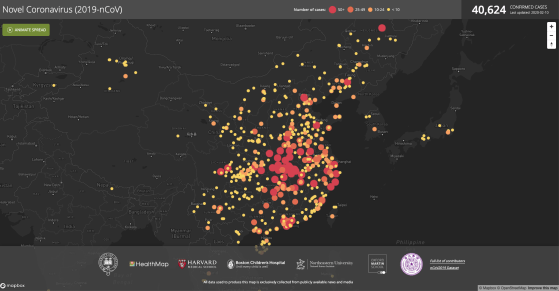
“It was just a different way to view what was taking place,” says Brownstein. “And in fact what ended up happening is government agencies started recognizing the value of this sort of intelligence gathering online.” Healthmap is now being used as a data source in the Early Alerting and Reporting project, an international collaboration among public health institutions, including the CDC, that aims to quickly detect biological threats around the world. It’s also used in the WHO’s Epidemic Intelligence from Open Sources initiative, which is intended to rapidly pick up on possible public health threats.
Other technological virus-fighting initiatives have gone further than simply tracking existing outbreaks. BlueDot, a Toronto-based health surveillance company launched in 2014, gathers disease data from myriad online sources, then uses airline flight information to make predictions about where infectious diseases may appear next (air routes, after all, are a common disease vector). Dr. Kamran Khan, BlueDot’s founder and CEO and an infectious disease physician, says this sort of predictive technology is essential both for other companies, like airlines, and for healthcare workers in hospitals, who may be the first to interact with potentially infectious patients. “If a traveler … comes from an area where there’s an outbreak occurring, they’re not going to go to the public health agency’s office; they’re going to go to the emergency department,” says Dr. Khan. “Does the clinician on the front line know how to recognize something that maybe they’ve never seen before?”
Some researchers, meanwhile, aim to identify potentially novel viruses before they even make the jump from animals to humans. The Global Virome Project (GVP), a proposed research endeavor that would build on a previous proof-of-concept project, intends to develop a genetic and ecological database of the vast majority of viruses in animal populations that have the potential to infect humans. Some scientists argue that mapping the human virome (the broad group of viruses that infect humans or live inside our bodies) is a “key priority” in health research. Now researchers say that the decade-long GVP collection effort will enable the development of new vaccines, drugs and other preventative measures before the next outbreak occurs. The enormous amounts of data they collect on viruses worldwide could also be used to train AI algorithms to predict which viruses in animals are more likely to be transferred to human populations.
“We can’t look in just a few species and just a few sites,” says Jonna Mazet, a professor of disease ecology at the University of California Davis and a GVP board member. “We need to really understand [if] it is possible to understand all of the … viral diversity that’s out there in advance.” It’s a huge undertaking. The forerunner of the GVP, USAID’s PREDICT project, had $200 million in funding. Researchers want several times that amount for the GVP; some countries have already begun self-funding the project in piecemeal.
Each of these efforts has its skeptics. Epidemiologists have long used techniques like natural language processing and analyzing airline routes, says Nita Bharti, an assistant professor of biology at Penn State University’s Center for Infectious Disease Dynamics. She argues that such methods have their limits, particularly when it comes to accounting for poorer areas of the world that may be generating less online data. “There are some blind spots and some really underrepresented populations when you’re aggregating across data that tend to represent either well-resourced or wealthy parts of all populations,” she says.
Meanwhile, understanding a virus doesn’t necessarily mean we’ll be able to stop it from spreading — Ebola was known for decades before an outbreak killed more than 11,000 people in western Africa between 2014 and 2016. “It could be interesting to catalogue all the viruses, more than useful,” says Bharti of programs like the GVP. “I don’t really see how it would be applied to a global health response, or how it could necessarily inform prediction.” That program’s projected $1.2 billion price tag is also raising some eyebrows in the cash-strapped world of infectious disease research. “We just need to address the diseases we already know about,” says Michael Osterholm, director of the Center for Infectious Disease Research and Policy at the University of Minnesota.
But advocates of these cutting-edge efforts argue that it’s wiser to prevent outbreaks in the first place rather than fighting them after they start. Researchers tend “to jump on to the last virus found and chase it, and we’ve done that over and over again” says Mazet. “It’s time to change that paradigm.”

Fox News Breaking News Alert
Fox News Breaking News Alert
This newly surfaced audio of Michael Bloomberg defending the NYPD's stop and frisk policy could hurt his standing with Democrati
02/11/20 3:11 AM
This newly surfaced audio of Michael Bloomberg defending the NYPD's stop and frisk policy could hurt his standing with Democrati
02/11/20 3:11 AM
Monday, 10 February 2020
Fox News Breaking News Alert
Fox News Breaking News Alert
Barr announces sweeping new sanctions, 'significant escalation' against left-wing sanctuary cities
02/10/20 2:47 PM
Barr announces sweeping new sanctions, 'significant escalation' against left-wing sanctuary cities
02/10/20 2:47 PM
New story in Technology from Time: A Physical Therapist Explains How to Fix Taika Waititi’s Apple Keyboard Woes
At the 2020 Academy Awards, director Taiki Waititi won “Best Adapted Screenplay” for his satirical film Jojo Rabbit, and took the stage to claim his first Oscar. “I dedicate this to all the indigenous kids in the world who want to do art and dance and write stories,” Waititi said, making history as the first person of Māori descent to win the award. “We are the original storytellers, and we can make it here as well.” Waititi ended his speech with a traditional Maori-language phrase expressing goodwill. “Thank you, kia ora.”
But the Oscar winner and Thor: Ragnarok director had a few more choice words to share after his acceptance speech, aimed at the tools on which he created the award-winning screenplay. When asked by Deadline about what writers should be discussing in the upcoming Writer’s Guild of America negotiations, Waititi launched into a humorous rant about what might be considered the most important tool in a writer’s arsenal.
“Apple needs to fix those keyboards,” Waititi responded. “They are impossible to write on. They’ve gotten worse. It makes me want to go back to PCs.”
Waititi continued: “On PC keyboards, the bounce back of your fingers is way better.”
Apple’s latest MacBook keyboards, which use a “butterfly” typing mechanism underneath the keys that reduces the millimeters-short distance traversed when a user presses down, have been derided since their introduction in 2015. Users’ complaints have ranged from a dissatisfying typing experience to unresponsive or duplicating keys, according to articles outlining the issue. Two class action lawsuits have even been filed against the company for its “constant threat of nonresponsive keys and accompanying keyboard failure.”
Waititi went on to take an informal poll from the crowd of reporters. “Hands up if you still use a PC,” he said. “You know what I’m talking about. It’s a way better keyboard. Those Apple keyboards are horrendous. Especially as the laptops get newer and newer … the keyboards are worse.”
The director even cited some physical ailments he believed to be exacerbated by the poor typing experience. “And I’ve got some shoulder problems, [Occupational Overuse Syndrome] — I don’t know what you call it here — which is in that tendon that goes from your forearm to your thumb. You know what I’m talking about,” said Waititi, who then pantomimed typing with cramped hands and hunched shoulders. “When you’re writing … you’re like this. We’ve just got to fix those keyboards, and WGA needs to step in and do something.”
Apple has since revised its keyboard design, though the improved Magic Keyboard is currently available only in its $2,399 16-inch MacBook Pro, released in 2019. TIME has reached out to Apple for comment.
While Waititi’s complaint may have been couched in some lighthearted humor, the problem plaguing Apple’s MacBook keyboards as of late has driven many to commiserate with the director, and raises the issue of ergonomics when writing. Occupational Overuse Syndrome, also known as Repetitive Strain Injury, is caused by prolonged muscle contractions, often due to maintaining the same position for long periods of time. It can lead to tremors, inflamed muscles, and difficulty performing other tasks, like grabbing objects.
“In the last 10 years there have been more and more studies going against the teaching of patients to sit in one exact position like we used to,” says Marianne Ryan PT, a Manhattan-based physical therapist and author of Baby Bod. “The best thing is to have more than one position to be in while sitting for a long period of time.”
The U.S. Occupational Safety and Health Administration (OSHA) recommends that people who use computers on a daily basis maintain a proper ergonomic setup — difficult advice to follow if you’re typing on a laptop with no additional accessories. According to OSHA, musculoskeletal disorders, like those caused by repetitive motion, cost the U.S. an estimated $15 to $20 billion in lost work time and medical claims each year.
“When I wrote my book … I actually had two different laptops that I worked on so I was changing my position and switching what I was doing,” says Ryan, who used a Bluetooth keyboard on a desk she found too uncomfortable to use when writing on her laptop.
For those dealing with muscle pain similar to Waititi’s self-described ailment, Ryan suggests elevating your laptop’s screen with a platform, and pairing it with a Bluetooth keyboard that allows for more freedom of movement and flexibility when repositioning yourself.
While expensive ergonomic keyboards with curved or two-piece designs are also an option, constant use and repetitive actions may still result in strain on the muscles, causing pain. “If he thinks the keyboard is doing it, he might need to get more than one to switch around,” says Ryan. For her patients, she also suggests a series of stretching and strengthening exercises to mitigate the damage done by repetitive actions. “If you’re bending your wrist for periods of time, you should do the opposite with stretching,” says Ryan. “So if you’re bending your wrist down towards the keyboard, what you need to do is take your fingers, bend your whole entire wrist, bending that backwards.”
Ryan also suggests seated back extensions, done by placing your hands behind your neck, spreading your arms wide, and bending backwards in your chair. “So whatever you’re doing for long periods of time, try to do the opposite as your prescribed exercise to break up the excess overuse.”

Subscribe to:
Posts (Atom)